Welcome to Thermaflex Insulation Asia's web blog

Origin: The Netherlands (Holland)
Established: 1976 (Holland), 1986 (Thailand)
Product: Sheet & Tube Foam Insulation (PE), In-Building & Underground Pipe System (Flexalen)

Thursday, July 21, 2011

Idea from New Product Conference in Holland

During 6-8 July 2011, I was invited to share the experience in the interesting seminar in Holland.  It was  the 2-day programs where colleagues from all over the world gathered to share their comment and market knowledge on the launching plan of new product.  Also, we discussed several things related to market in each different countries.

There were also invited guests to our seminar to gain our knowledge as well.

Thermaflex's new product has been invented from the idea that plastic insulation is less flexible than rubber insulation.   Its "Lambda Value" is more stable than rubber (rubber tends to have higher (worse) lambda value with more thickness).  This is the newly innovative product which is not "Pure PE" anymore.  People always think of our product as "PE Insulation", but now we call our new product line as "Polyolefin (PO) Insulation".

Talking about Polyolefin, you need to take a look at the family of plastic.  Polyolefin is like the main category where it has its sub-category as PE, PP, PVC, and so on.  This is the newly developed formula where Thermaflex has reached its first real flexible insulation to supply to the market, yet still maintain its high quality.  The R&D of Thermaflex Holland has boasted to reach Class 0 with this new product.  At the moment, it's under the production test run and test certificate submission.

From this seminar, I have learned a lot, especially I have learned that most countries have a unique requirement from their customer.  For example, in Russia they need to have the test called "Linear Material Shrinkage", which is the test of shrinkage at the temperature of 80 Celsius for several hours test period.  This kind of test is not needed, or I can say it's not even recognized in most of Asian region.

Another similar idea of unique requirement is for market in Australia, where they always refer to the insulation property by using "R Value".  Again, this R-Value is not something we are interested in Asia, but Lambda value is more important to customers in Asia.

There is a "funny" info that I learned from this seminar, which I will tell you later.  However, this funny info relates to the basic knowledge of SCC (Stress Corrosion Cracking).

SCC is the serious issue when the insulation is not installed correctly.  It's related to the moisture that will penetrate into the layer of insulation and pipe.  However, the 'fastest corrosion' is found in the "Nitrile Rubber Insulation"( not EPDM Rubber Insulation).  This is due to the blowing agent of Nitrile Rubber consist of Ammoniac, which will react to the moisture, and stimulate faster SCC.  After installing for long time there is a chance that moisture could leak into the joint of insulation.  The moisture will then have a reaction with the ammoniac in Nitrile Rubber, which eventually will cause SCC.  After all, the correct installation is very important.

The funny thing I heard from this seminar is that one of the rubber insulation suppliers claims that their product has "SCC Indicator" property.  They said with their product the SCC can be detected by bare eyes.  That is when there is a "swell" of insulation surface.

Well, the rubber insulation of any kind (either nitrile or EPDM) has a very high Water Vapour Diffusion ( µ-value), but the fact is that they can reach such high value due to their 'skin'. If skin is scratched, then µ-value will be gone.  Their inner layer is not 100% closed cell structure, unlike PE or Polyolefin product.

You can do the comparison test easily by cut the same size of both Rubber and PE insulation samples (any PE insulation would be OK) into the bucket of water for a week.  Before you put into the water, weighing each sample weight (at the same size, you will notice PE has less weight than Rubber which is due to the difference in density).  After a week, you weighing again both samples' weight.  You will then see the difference.  You will see which one absorb water!

There are also more interesting points from this seminar about our product, test certificate, and competitors.  Let me continue this later.

Cheers!

Friday, July 01, 2011

Fiber Glass & Rubber (VS) PE Insulation

Normally, people are fond of using fiber glass, a kind of open cell structure insulation, to be their priority when thinking of ceiling insulation or duct insulation (due to cheaper cost!).  The idea has started to change recently by concerning the disadvantage of fiber glass.

Fiber Glass is in fact harmful to human, yet environment.  The contact to human skin will cause a severe irritation.  If we inhale the dust of fiber glass, it will stay in our lung and can be seen as black spot via X-Ray Film.  Moreover, in the situation of fire, fiber glass will release a high density of smoke, as well as toxic vapor.
"Technically, the open cell insulation has weak point due to its absorption of humidity.  This is the reason fiber glass will need to have protection, the aluminum foil."
In the work such as ceiling or duct insulation, the aluminum foil of fiber glass could be damaged by small creatures e.g. rats.  When the skin (aluminum foil) damaged, humidity/moisture will go inside.  Due to the open cell structure, fiber glass material will keep the moist.  As time goes by, theoretically fiber glass will get thinner thickness.  This means the thermal conductivity property will be lower over the time.

"This is the renovation of my office.
People have to wear a lot of things for the maxumum protction of  their health,
in order to remove the old fiber glass that was installed long time ago!"

You can follow this link to see: How we attach PE Sheet Insulation to Ceiling Tile

Rubber insulation is also not 100% closed cell.  There is a test where you can cut small pieces of rubber insulation and put into a container full of water, then leave it for a week or two.  You will see rubber also absorb water.  In reality, rubber insulation has a nice skin, which is the strong point to prevent moisture absorbed into its inner layer.

PE Insulation, on the contrary, is a 100% closed cell structure.  Even the skin is scratched or damaged, inner layer is still closed cell.  As the result, moisture/humidity can not be absorbed, and you can be sure the product will stay with you long time.  Talking about moisture, you can also test the same way as rubber for a week or two dip PE Insulation into a container full of water.  It will not absorb any water.  Well, test both materials at the same time and see for your eyes!
"The absorption of water can be measured by weighing the test specimen before and after dipping into the water."
Further info about PE Insulation, PE Insulation (Non-Crosslink Type)  can be 'recycled' and not harmful to the environment.  If you contact the "Green Label" office, which has its branches in many countries, you will find out that PE is already in the safe material list.  Unlike other material, where you have to submit many relevant documents in order to use the renown logo of "Green Label".

Tuesday, March 22, 2011

The 1st Thermaflex International Conference

From 13-15 March 2011, Thermaflex International Holdings BV. (The Netherlands) has organized the 1st Thermaflex International Conference in Geisenheim, Germany.

This event has changed the annual meeting style at Thermaflex.  We are no longer present each other what we can do in the past year, but we learn more from each other, yet from outsider.  All subsidiaries all over the world participated in this event with a big dinner and a warm welcome from Thermaflex Holdings' management team.

Friday, February 25, 2011

The 1st Thailand Seminar on "Flexalen"

Hello All,

After long time no update on this blog, finally I have come up with the new event in Thailand.  It's the first seminar for Flexalen - The Pre-Insulated Pipe System.

The event was held at Amari Pattaya & Resort Hotel. Most companies are Thai, except one from Vietnam.  I have to make the name of our customers confidential as this is the open space on the Internet where our competitor could have seen these info as used against us.

Anyway, the one-day seminar went well with more understanding from customers at the end of the day. We are now looking forward to progress as the result from this seminar, also looking forward to have more of this seminar in the near future for other companies as well.


Friday, August 06, 2010

UV - The effect of outdoor application

During our exhibition in Phuket Island, our sales team had a chance to visit a prospect in the downtown. They are the hotel where they want to replace the rubber insulation with our renown UV protected alu-foil insulation.

From these photos, you will see all rubber tube insulations start to wear off.  As the result, everyone should bear in mind of the extreme result from UV.

In the photos below, you will notice they even have a roof partly cover the whole pipeline, but it's still not enough.  These pipeline has been insulated no more than 3 years!

Even you have something cover as a roof!!
Still the product get UV on the outer surface!
So, it's clear that every kind of insulation is not suitable for outdoor use without "Protection"!!
This is a good sample for some customer whom underestimate UV!
It's now clear, right?

Thursday, August 05, 2010

Indonesian customer visited Thailand (July 2010)

During 22-24 July 2010, Thermaflex Insulation Asia had a chance to welcome our customer from Indonesia, the long-time customer of Thermaflex, to Thailand.

The owner and his sales engineer manager had brought 4 customers to Thailand to visit our factory and learn more about our product. One of them is the consultant who taking care of big construction project in Indonesia.

The trip started with our company presentation and product demonstration. Our project sales manager gave his presentation and answered questions.

After the half day meeting within our company, they all ended the day with our factory tour guided the production manager and our CSS Manager.

Everyone in front of the factory building
Everyone is ready in the meeting room. Opening speech by myself.
Prospects discussed about our product as they were listening to  our presentation
Presentation for sheet-roll tube and pre-fab
Factory tour by our production manager (Blue Shirt)
The next day, we took the tour in Bangkok (The Grand Palace)
After customers went back, TIA got 3 containers urgent order right away
Thanks to customers.  We were glad to welcome them all to our country.

Wednesday, August 04, 2010

Thermaflex - The Exhibition in Phuket

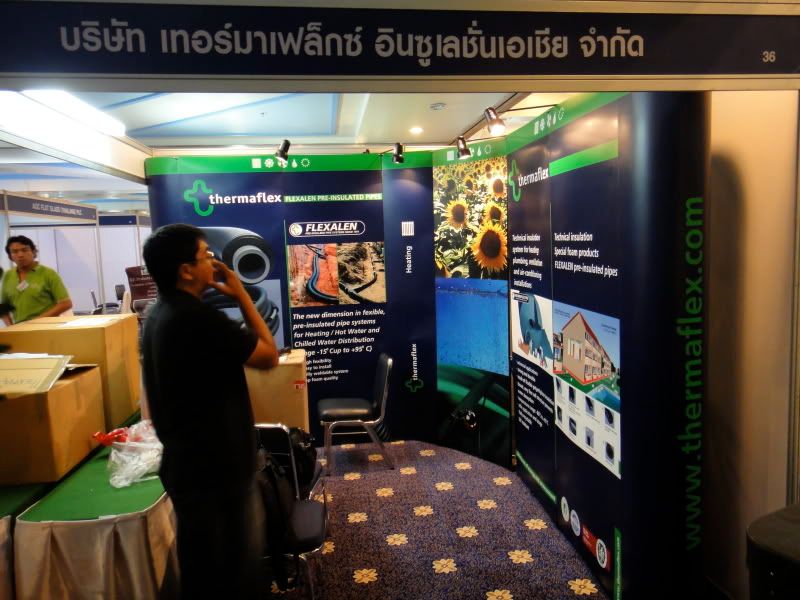
Recently, Thermaflex Insulation Asia Company Limited had joined the main event in the South of Thailand, Phuket Island.  Phuket is one of the most popular tourist destination in Thailand. Every year there are many construction sites for resort, hotel, and villa to support the demand of tourists from around the world.


Phuket is the unique tourist destination, especially for European. Tourist does not just come to stay in a hotel or a resort, but some of them prefer to purchase their own house, or so called "Villa".  This is the point that many foreign contractors have come to settle their business in Phuket Island.  As the result, the land value in Phuket is very high and attractive to all investors both Thai and foreigner.


Just finish setting up, Mr. Prajak is considering the balance of backdrop.
Before we clear the boxes..
This is the front of the exhibition venue (Royal Phuket City Hotel)
Samples set on table
TIA Sales Team for exhibition
Visited by the chairman of Phuket Chamber of Commerce on grand opening day

Foreign business owners in Phuket visited our booth.
We decided to buy an advertising in Construction Magazine, where they set the model to be shot for ads.
Prospects visit
Packing up and preparing to go home the next day